
BLOG
Why Fiscal Receipts Fade and How to Preserve the Data for Your Accountant
12 November 2026 · Đorđe M. Đokić
You filed the fiscal receipt neatly, but a few months later the amount and date are barely visible. Here is why thermal paper fades and how to get the data to your accountant before it disappears.
You filed the fiscal receipt neatly, but a few months later the amount, date, and vendor name are barely visible. When the time comes to hand the documentation to your accountant, you are left with a slip of paper from which the data can no longer be reliably read.
A faded receipt is not just a paper problem. It is a risk to expense visibility and the orderliness of your business records.
Why do fiscal receipts fade?
Most fiscal receipts are printed on thermal paper. Instead of conventional ink, the print is created by heat acting on a special coating. That coating is sensitive, so over time the print can fade or the paper can darken.
Deterioration is accelerated in particular by:
- Heat: a receipt left in a car, next to a radiator, or near another heat source.
- Sunlight: prolonged exposure to light reduces legibility.
- Moisture and friction: carrying receipts in a pocket or wallet can damage the surface.
- Contact with certain materials and chemicals: glue, cleaning agents, and some plastic sleeves can affect the print.
The speed of fading depends on paper quality and storage conditions. It is therefore unwise to assume every receipt will remain legible until the moment you need it.
What does a faded receipt mean for your company?
An illegible receipt makes it harder to match an expense to a specific purchase. Your accountant may lack the data needed for verification and booking, and the company has to chase documentation afterwards or explain how the expense arose.
A particular problem arises when several employees collect receipts without a shared place to store them and a record of what has been handed over.
How to preserve the data while the receipt is still legible
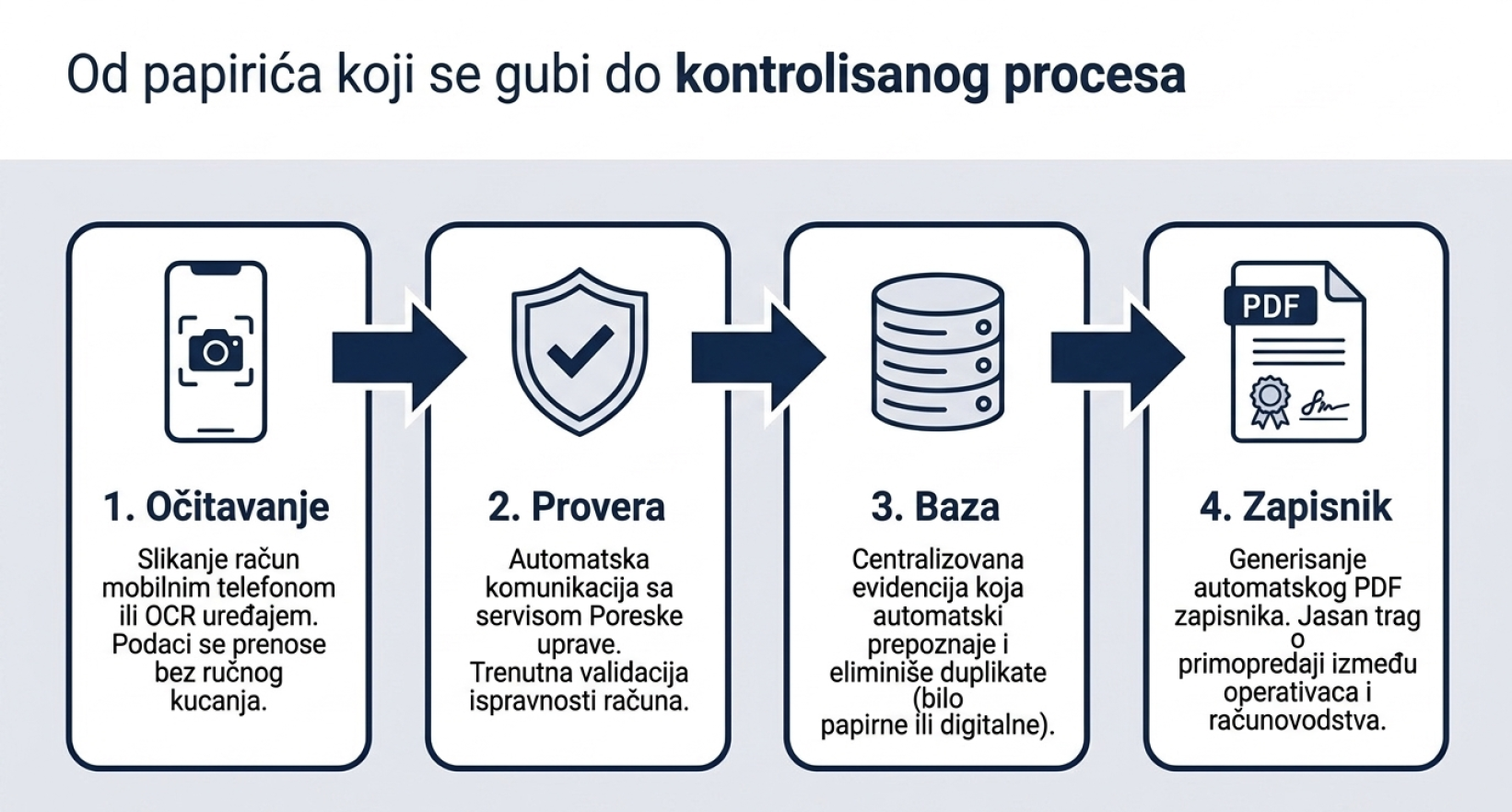
1. Photograph it right after the purchase
Photograph or scan the entire receipt on a flat surface in good lighting. Check that the text, amounts, and QR code are clear, with no cut-off edges or glare.
2. Verify the data
While the receipt is legible, check the vendor, date, amount, and buyer details where required. If the receipt carries a verification QR code, use it to check the data through the Tax Administration system. A photograph alone is not proof of a receipt's validity.
3. Orderly records
Store the digital copy in a shared business archive. Alongside it, record the date, supplier, amount, purpose of the expense, and the employee who submitted it. That way the receipt does not end up lost among photos on a private phone.
4. Handover to the accountant with a record
Prepare a list of handed-over receipts with the handover date and total amount. The record makes it easy to check what was delivered, what is missing, and what needs further explanation.
Does a photograph replace the original?
Do not automatically throw away the original after photographing it. A digital copy preserves the legibility of the data, but the way documentation must be kept and whether a copy is acceptable depends on the type of document and the regulations in force. Agree the procedure and retention periods with your accountant. Keep originals in a dry, dark place, away from heat.
Preserve the data before it disappears
The best solution is not searching for a receipt once it has already faded, but a simple procedure: capture, verification, record-keeping, and handover to the accountant with a record.
Want a complete solution for tracking and preserving your company's fiscal receipts? Contact DJDJ Advisory at +381 62 209 573 to discuss a procedure tailored to your company, or request a quote within 24h.
Ask a question about this post
The AI assistant answers only based on this article. Conversations are not saved.
What would you like to know?
Ask about this article's topic, e.g. "What is the key takeaway?"